12 October 2026LANTEK Computers
Artificial intelligence has moved from experimentation to business necessity.
Every week, organisations evaluating AI ask the same question: “Should we use ChatGPT, Claude, Gemini, Grok or Microsoft Copilot?”
It is a reasonable question, but it is often the wrong place to start.
Most businesses focus on the AI model itself. They compare features, pricing, accuracy and performance. While those factors matter, a larger concern is often overlooked: how will AI access your business data, and who controls that access?
Before selecting an AI model, organisations should ask a more important question: How do we allow employees to use AI without exposing company information, customer data, intellectual property or regulated content?
That is where the conversation shifts from AI models to AI governance.
The best AI model is not enough. Your business also needs a secure and governed way to use it.
The AI model is only one piece of the puzzle
Leading AI platforms can generate content, analyse documents, answer questions, summarise information and assist users across many business tasks. Organisations may be considering:
- OpenAI ChatGPT
- Anthropic Claude
- Google Gemini
- xAI Grok
- Microsoft Copilot and other enterprise AI services
For a business, the decision cannot rest only on which model produces the most impressive answer. The surrounding security, identity, permissions, compliance and governance framework is just as important.
What often matters more is:
- Who can access company information
- Which documents and data sources AI may use
- How sensitive information is protected
- How organisational and regulatory requirements are enforced
- Whether activity can be monitored and audited
- Whether business data remains under organisational control
Without these controls, even a highly capable AI model can introduce unnecessary business risk.
Why businesses are concerned about AI
The questions we hear from business leaders are practical and valid:
- Where does our data go?
- Can AI see confidential files?
- Could our business information be used to train a public model?
- How do we meet POPIA and industry requirements?
- Can employees accidentally expose sensitive information?
AI adoption should not come at the cost of security, compliance or governance. For organisations in financial services, healthcare, legal services, manufacturing, education, government and other regulated sectors, AI needs to be introduced responsibly.
The Microsoft 365 Copilot approach
Microsoft 365 Copilot is designed to bring AI into the Microsoft 365 environment where identity, access, permissions and governance controls can be applied. Rather than treating AI as a separate tool outside the business, Copilot can form part of the organisation’s existing Microsoft 365 security and compliance approach.
The central principle is straightforward: users should only be able to work with information they are already permitted to access. AI should not become a shortcut around existing access controls.
What makes Copilot different
The business value of Microsoft 365 Copilot is not simply that it provides access to AI. Its value also comes from how it fits into the Microsoft environment businesses already use.
Depending on the organisation’s Microsoft 365 configuration, the wider control framework may include:
- Microsoft Entra ID for identity and access
- Conditional Access and multifactor authentication
- Microsoft Purview information protection and governance
- Data Loss Prevention policies
- Sensitivity labels
- Retention and data lifecycle controls
- Audit logs and monitoring
- Microsoft Graph and existing user permissions
This creates a more practical foundation for introducing AI while maintaining organisational control over identities, information and access.
AI choice and AI governance
Do not ask only, “Which AI model is best?” Ask, “How can we use AI safely throughout the business?”
Organisations that focus exclusively on the model may overlook the areas that determine whether an AI rollout is sustainable:
- Data protection
- Access control
- Regulatory obligations
- Information governance
- Risk management
- User accountability
- Monitoring and continuous review
The strongest AI strategy balances innovation with control. It gives employees useful tools while setting clear boundaries around how company information may be accessed and used.
A practical example
Imagine an employee asks AI: “Summarise all customer renewal opportunities for this quarter.”
The question is not only whether the AI can produce a useful summary. The business also needs to know which emails, files, meetings and records the employee is authorised to use, whether sensitive information is protected, and whether the request can be monitored under company policy.
In a governed Microsoft 365 environment, the intention is for Copilot to work within the user’s existing permissions. If a user does not have access to information, AI should not provide a new route to that information. Existing access control remains fundamental.
Visualising enterprise AI governance
The diagram below illustrates the intended relationship between users, Microsoft 365 applications, identity and security controls, organisational data, Microsoft 365 Copilot and approved AI models. It also shows governance checkpoints that can be applied before and during AI adoption.
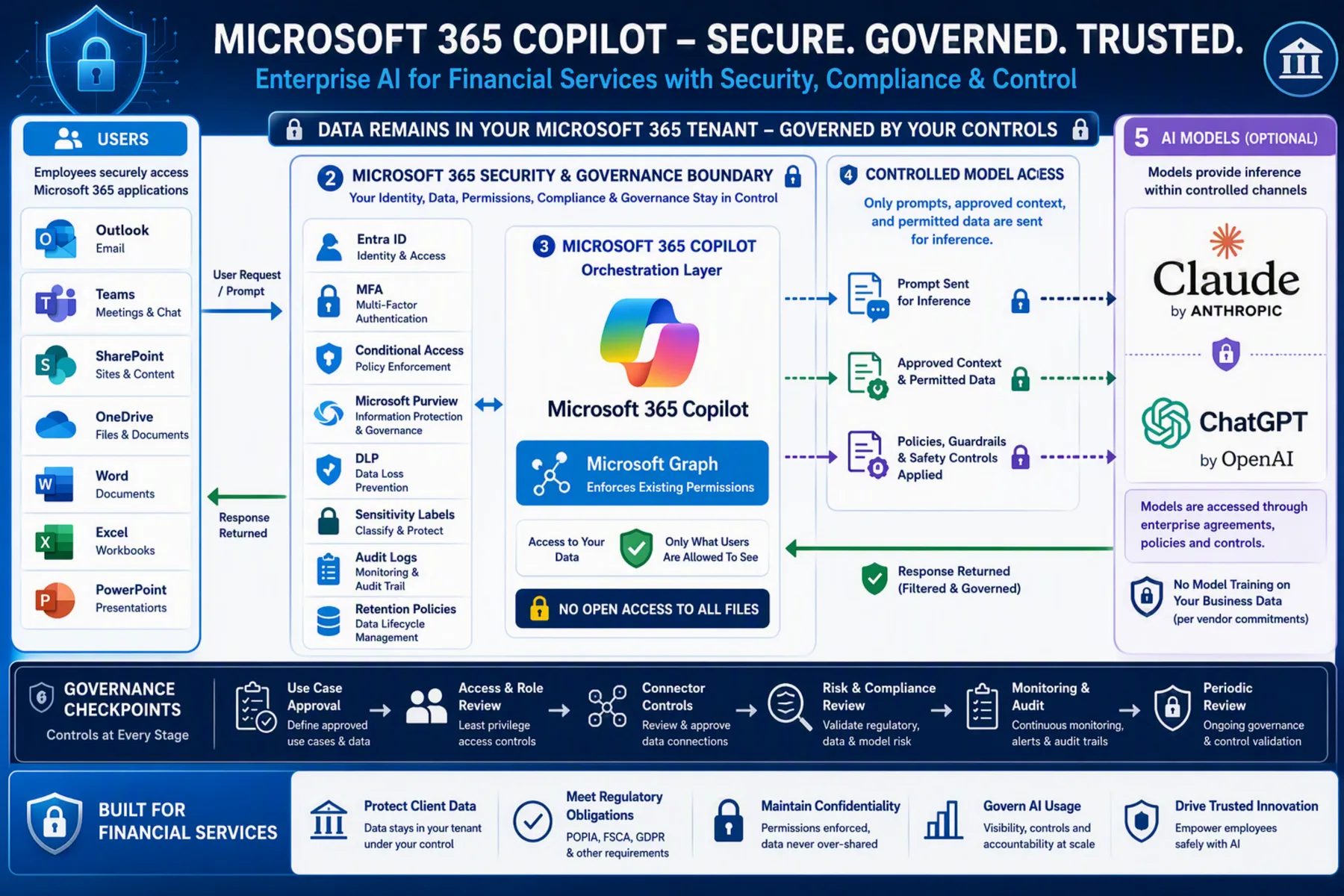
The message for business leaders is simple: AI model choice should sit inside a broader framework of identity, permissions, data protection, compliance and oversight.
The future is not one AI model
The future of business AI is unlikely to belong to a single model. New models will emerge, capabilities will improve and organisations may use different models for different tasks.
The organisations best positioned to benefit will not necessarily be those that selected one “winning” model. They will be the organisations that built a secure, governed and scalable foundation that allows them to adopt new AI capabilities responsibly.
How LANTEK helps
LANTEK helps businesses move from AI interest to practical, controlled adoption. Our services can support:
- AI readiness assessments
- Microsoft 365 Copilot licensing and enablement
- Microsoft 365 security and compliance reviews
- Microsoft Purview and information protection planning
- Data governance and access reviews
- User adoption and training
- AI governance frameworks and acceptable-use guidance
Whether your organisation is evaluating ChatGPT, Claude, Gemini or Microsoft 365 Copilot, the first step is to understand how AI fits into your security, compliance, data and governance requirements.
The question is no longer only, “Which AI should we choose?” The better question is, “How do we use AI safely, securely and responsibly?”
When your organisation is ready to answer that question, LANTEK can help you evaluate the risks, establish the right controls and introduce Microsoft 365 Copilot with a clear business case.